
Modern European engines run hotter, rev faster, and rely on tighter internal clearances than traditional domestic platforms, making conventional oil unsuitable. Saving $30 or $40 on a quick-lube oil change is tempting, but conventional oil breaks down fast under high heat, leaving behind thick sludge that starves turbo bearings and jams variable valve timing solenoids. To keep your BMW, Mercedes-Benz, Audi, or Volkswagen running without costly rebuilds, you need factory-approved full synthetic oil carrying the exact OEM specification your manual calls for.
What Makes German Suspension Setups So Complex?
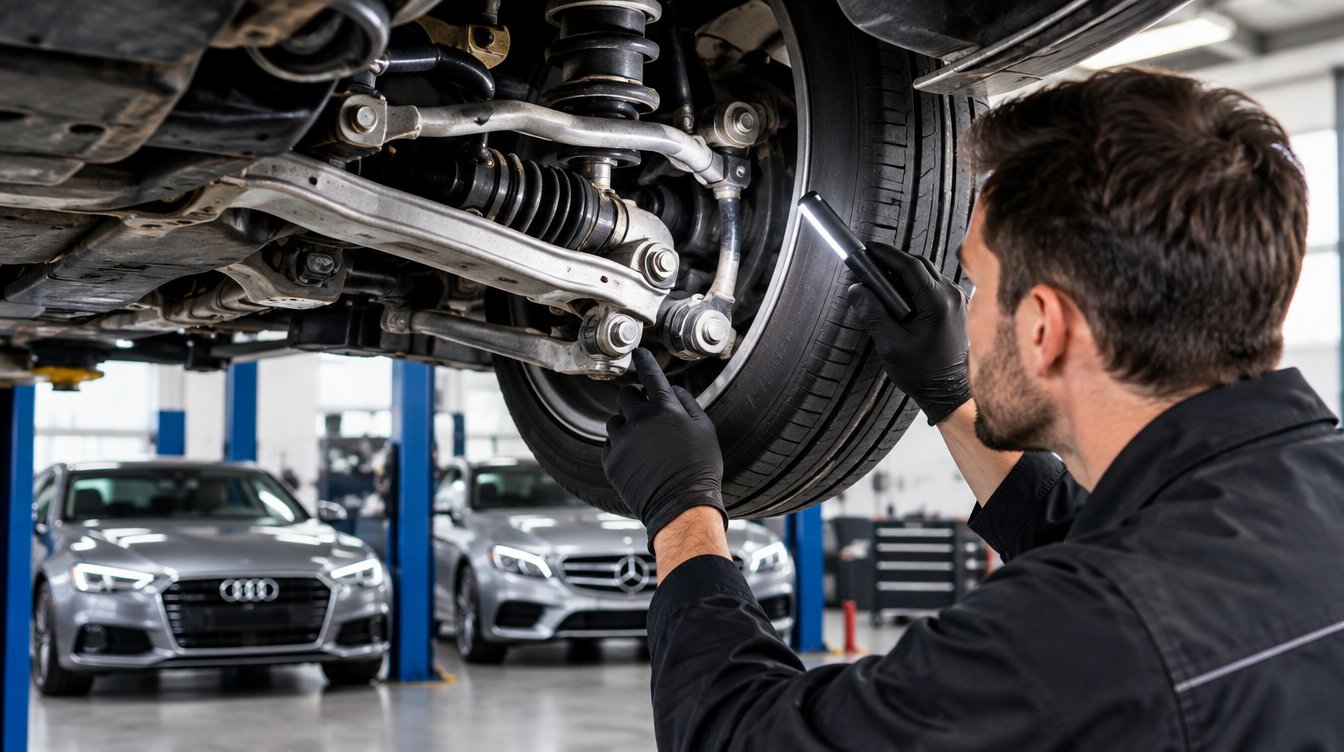
Audi and Mercedes-Benz build their vehicles to feel glued to the road at highway speeds while gliding quietly over city streets. To pull that off, an Audi front suspension skips the basic single lower control arm found on domestic cars. Instead, it uses a multi-link arrangement featuring four independent arms per front wheel, each packed with hydraulic, fluid-filled bushings to isolate road shock. Mercedes-Benz takes a similar route with front double-wishbones and complex multi-link rear axles, often paired with self-leveling AIRMATIC air struts.
That refined driving feel on the Sea-to-Sky or along Kingsway comes with a catch: moving parts. Every link, bushing, and ball joint carries high rotational loads while keeping your wheels pointed true. Over years of daily commuting across the Lower Mainland, coastal rain, road grit, and daily pothole hits take their toll. Protective rubber seals dry out, internal grease washes away, and quiet components start to complain.
Decoding the Noises: Creaks, Clunks, Clicks, and Hisses
Tracking down a chassis problem comes down to what the noise sounds like and exactly when it happens:
Mattress-Style Creaking Over Speed Bumps: If your car lets out a drawn-out groan or squeak over speed tables and dips on local Burnaby streets, you are likely hearing dried-out, torn control arm bushings or sway bar mounts. Once the rubber hardens and cracks, it loses its damping effect and metal starts binding against raw rubber.
Rhythmic Clicking While Turning: A distinct, rapid clicking that speeds up as you turn the wheel at low speeds—like pulling into a parking stall at Metrotown—is the signature sound of a failing Constant Velocity (CV) axle joint. Once the rubber boot tears and slings grease, grit gets inside and chews up the internal bearings.
Dull Thuds on Uneven Asphalt: Feeling a loose "thud" through the floorboard or pedals when rolling over manhole covers along the Lougheed Highway usually points to worn sway bar end links or a lower ball joint that has developed internal play.
A Hiss or a Humming Pump (Mercedes AIRMATIC): If you hear air hissing from a wheel well after parking, or notice the suspension compressor running nonstop, an air strut bladder is leaking or a pneumatic air line is cracked.
Turning up the stereo to drown out these sounds never works for long. A sloppy suspension ruins the composed ride you bought the car for, leads to unpredictable wandering on the highway, and compromises your stopping distances when you have to brake hard.
Why Quick Band-Aids and Generic Shops Miss the Mark
When drivers take a noisy German vehicle to a generalist shop, the problem is often misunderstood. A quick blast of silicone spray onto dry rubber might silence a squeak for a few days, but the underlying tear is still there. Other times, shops will swap only one visibly worn arm, completely ignoring the surrounding links.
Because an Audi or Mercedes suspension works as a unified geometric unit, one sloppy joint forces adjacent parts to absorb double the impact. If an upper control arm bushing gives out, the lower ball joint takes the brunt of the hit, accelerating its wear. Finding the true culprit takes an undercar inspection on a drive-on lift using pry-bar deflection testing to check real tolerances against factory spec, followed by installing OEM-grade replacement parts.
Real-World Suspension Care for Local Commuters
Keeping your German chassis tight and quiet comes down to a few basic habits:
Check the Rubber Boots at Every Oil Change: Have your mechanic visually inspect all ball joint boots and CV axle boots for small tears during routine services. Catching a split boot before the grease washes out saves you the cost of an entire axle assembly.
Go Easy on Curbs and Speed Bumps: Lightweight aluminum control arms are built for precision handling, not curb hits. Bumping into curbs while parking pinches hydraulic bushings and throws wheel geometry out of line.
Watch Your Morning Ride Height: If your Mercedes has AIRMATIC suspension, glance at the car in the driveway before turning it on. If one corner is sitting low, an air spring is leaking and needs attention before it burns out the expensive compressor pump.
Burnaby’s Trusted Independent European Specialists
You shouldn't have to live with mystery clunks and rattles in a premium car. Leaving worn suspension parts alone leads to ruined tires, loose handling, and much bigger repair bills down the line.
At Daniel’s Auto Service on Russell Ave, our technicians know the ins and outs of modern Audi and Mercedes suspension systems. We isolate the exact failed bushing, ball joint, or air line with dealer-level precision and fix only what is actually worn using genuine OEM parts. Get back the tight, quiet, comfortable ride your car was built to deliver with the straightforward service of a local family shop.
Frequently Asked Questions
-
A minor squeak will not leave you stranded immediately, but it means the bushing has broken down and can no longer absorb impact. Left alone, the resulting play puts excess stress on your steering rack and quickly wears out the inner edges of your tires.
-
Audi’s multi-link setup uses multiple small bushings to soak up road vibration from every angle. Because they handle continuous braking and steering loads, the rubber typically wears out every 80,000 to 120,000 kilometers under regular commuter conditions.
-
It depends entirely on the source. A simple sway bar link is a quick, inexpensive fix, whereas a control arm or an AIRMATIC strut requires more labor and parts. An independent specialist can isolate and replace just the worn component rather than quoting a full assembly swap.
-
If an axle joint shears while you are driving, the wheel loses engine power immediately. The loose axle shaft can also whip around inside the wheel well, damaging brake lines, wiring, and nearby suspension arms.
-
Yes. Replacing control arms, ball joints, or tie rods changes your chassis geometry. We perform a precision digital four-wheel alignment after every suspension job so your car tracks straight and your tires wear evenly.