
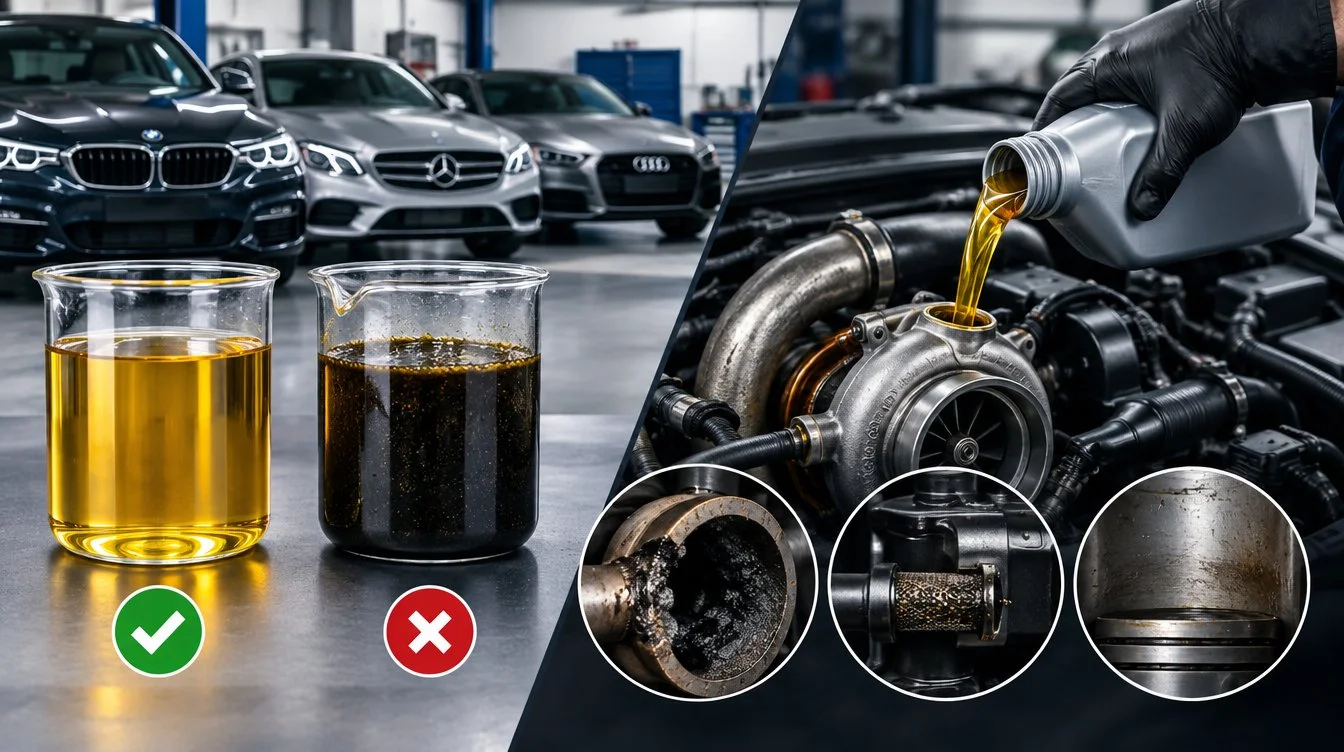
Modern European engines run hotter, rev faster, and rely on tighter internal clearances than traditional domestic platforms, making conventional oil unsuitable. Saving $30 or $40 on a quick-lube oil change is tempting, but conventional oil breaks down fast under high heat, leaving behind thick sludge that starves turbo bearings and jams variable valve timing solenoids. To keep your BMW, Mercedes-Benz, Audi, or Volkswagen running without costly rebuilds, you need factory-approved full synthetic oil carrying the exact OEM specification your manual calls for.
What Makes European Engines So Hard on Motor Oil?
Pop the hood of any late-model BMW, Audi, or Mercedes, and you will see how tightly packed everything is. Automakers across Europe have mastered getting massive horsepower out of smaller, direct-injected 2.0-liter four-cylinders and twin-turbo straight-sixes. To pull off that balance of performance and fuel economy, engineers build these engines with incredibly tight tolerances and run them at high operating temperatures.
When you start your car on a crisp Burnaby morning, the engine oil has to travel through passages no wider than a needle tip within seconds to protect your camshafts and valve gear. Conventional oil, refined straight from crude oil, has inconsistent molecular sizes and natural contaminants. As it circulates through a red-hot turbocharger shaft spinning at over 5,000 RPM, it oxidizes, thins out, and leaves scorched residue behind.
Full synthetic oil is custom-built at a molecular level. Every single molecule is uniform, which keeps the fluid stable whether your engine is cold-starting on a wet winter day or crawling up Burnaby Mountain in bumper-to-bumper traffic. It flows instantly, coats metal surfaces evenly, and will not cook when the turbo gets scorching hot.
What Actually Breaks When You Put the Wrong Oil in a German Car?
The damage from using conventional oil in a European car does not happen with a loud bang the minute you drive out of the bay. It is a slow, quiet process that sneaks up on you over a few thousand kilometers:
Burnt Turbo Oil Lines (Coking): When you shut off your vehicle after a highway run, the oil sitting in the turbocharger lines absorbs lingering heat. Conventional oil bakes against the hot metal surfaces, forming gritty carbon crusts called "coking." Those flakes eventually block oil delivery, destroying the turbo bearings.
Sluggish Variable Valve Timing (VVT) Solenoids: Systems like BMW's VANOS or Audi's Cam Phasers rely on pressurized oil to advance or retard valve timing on the fly. Heavy conventional oil sludge plugs the tiny solenoid screens, leading to rough idling, sluggish throttle response, check engine lights, and eventually stretched timing chains that cost $3,000 to $6,000 to replace.
Oil Starvation and Scored Cylinders: As conventional oil shears down under pressure, it burns off through the exhaust. If the oil level drops without you noticing, friction quickly strips the protective glaze from cylinder walls and piston rings, causing irreversible engine wear and heavy smoke from the tailpipe.
There is nothing worse than looking down at your dash on Highway 1 and seeing the low-oil-pressure light blink red. Knowing that a minor choice at a drive-thru oil bay caused thousands in internal damage is an expensive, frustrating pill to swallow.
Look for the Approval Code, Not Just the Bottle Viscosity
Grabbing a bottle of 5W-30 or 0W-40 off a retail shelf does not automatically mean it belongs in your engine. European manufacturers set rigid internal benchmarks that oil blenders have to test and certify against:
BMW Longlife (LL-01 / LL-04): Formulated to resist thermal shearing and high-shear friction across high-revving turbo platforms.
Mercedes-Benz (MB 229.5 / MB 229.51): Rigorously tested for extended drain resilience, soot dispersal, and particulate filter safety.
Volkswagen / Audi (VW 502 00 / 504 00 / 508 00): Tailored specifically to stop carbon buildup on intake valves and protect complex direct-injection fuel systems.
If the bottle in your technician's hand does not clearly state the specific OEM approval code for your model, that oil lacks the additive package needed to keep your warranty valid and your internal components protected.
Reliable, No-Nonsense European Service in Burnaby
Routine maintenance should give you peace of mind, not leave you second-guessing whether the right fluid went into your crankcase. High-volume quick-lube shops make their margins on speed and generic bulk drums, but your European powertrain deserves real mechanical care.
At Daniel’s Auto Service on Russell Ave, we treat every vehicle on our hoists with the same care and technical precision we put into our own cars. We stock only OEM-approved full synthetic oils and factory fleece filters designed for your car's exact year and trim. You get dealership-level knowledge, completely transparent advice, and none of the corporate sales games.
Frequently Asked Questions
-
No. Even with very frequent intervals, conventional oil simply cannot withstand the extreme heat spikes inside modern European turbochargers. The oil begins shearing and oxidizing the first time it reaches peak operating temperature.
-
Have the system drained, the filter replaced, and fresh OEM-spec synthetic oil added as soon as possible. Driving on it for an extended period invites sludge buildup in the timing solenoids and turbo oil supply lines.
-
European synthetic formulas use higher-quality synthetic base stocks (Group IV PAO or Group V esters) and expensive additive packages to pass the stringent manufacturer testing required for long drain intervals and tight engine tolerances.
-
While factory manuals suggest intervals up to 15,000 or 20,000 kilometers, our coastal climate and stop-and-go commuting stress oil quickly. Changing your full synthetic oil every 8,000 to 10,000 kilometers is the sweet spot for preserving your engine for the long haul.
-
We pull your vehicle's engine code and VIN directly from the manufacturer database. That tells us the exact factory specification required before a single drop of fluid is poured into your engine.